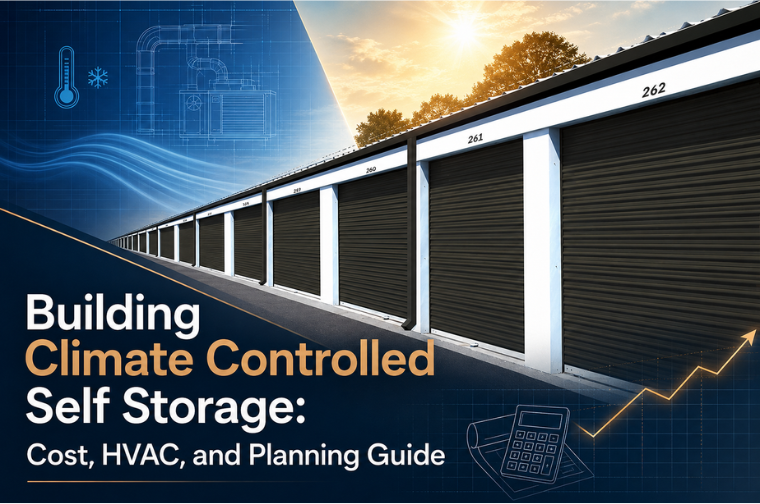
Most investors building a climate controlled storage facility ask two questions first: what is this going to cost, and what does the building actually need to hold a regulated climate year-round? This guide answers both — in plain terms, in the right order.
Building climate controlled self storage requires more than ordering a steel building. The structure needs four things that standard storage does not: adequate insulation with a specified R-value, a properly sized HVAC system, a vapor barrier throughout the building envelope, and an interior design that keeps the regulated zone sealed and efficient. Get those four components right and the building holds a stable climate. Shortcut any one of them and the HVAC system fights the weather instead of regulating it.
This guide covers the complete planning sequence — from the first site decisions to the day you open — along with the cost factors that drive the budget and the unit mix strategies that make a climate controlled facility financially viable.
What This Guide Covers
- The four building components a climate controlled facility cannot skip
- Insulation R-value requirements and why thermal bridging matters in metal buildings
- How HVAC systems are sized and what happens when they are sized wrong
- Every cost factor from land through installation — organized by phase
- Unit mix planning and how to maximize revenue per square foot
- Whether to build climate controlled units, standard units, or both
- The full planning sequence from site to open
- Get a quote on your climate controlled storage building — call (844) 315-3151
Planning a climate controlled storage facility? Talk through your site, unit mix, insulation needs, HVAC planning, and building package with a storage building specialist. Call (844) 315-3151.
What a Climate Controlled Storage Building Actually Requires
Climate controlled storage is not a feature you add to a standard building after the fact. It is a design decision that shapes every component of the structure, from the foundation up. Four systems must work together to achieve and hold a regulated interior environment.
🏗️ Building Envelope
Sealed and Insulated
Walls, roof, floor slab, and all penetrations must form a continuous, airtight boundary. Any gap is a path for outdoor air — and outdoor humidity — to enter.
🌡️ Insulation
R-13 Walls / R-19 Roof
Minimum specifications for metal buildings targeting 55–85°F. Higher R-values reduce HVAC operating load and improve long-term utility costs.
💨 HVAC System
Sized to Building Load
Controls both temperature and humidity. Must be calculated for the specific building dimensions, not approximated by square footage alone.
🛡️ Vapor Barrier
Required Throughout
Prevents exterior moisture from penetrating the wall and roof assembly. Without it, humidity control is impossible regardless of HVAC capacity.
Insulation: The R-Values That Actually Hold a Stable Climate
A climate controlled storage building requires a minimum of R-13 insulation in the walls and R-19 or higher in the roof panels. Those numbers are minimum thresholds, not targets. Facilities in climates with extreme summer heat or below-zero winters typically benefit from higher R-values in the roof, where the majority of heat gain and loss occurs.
Metal buildings present a specific insulation challenge called thermal bridging. Heat transfers readily through steel framing, bypassing the insulation layer between studs and moving directly through the metal. A building with properly specified insulation but no thermal break in the framing will lose climate control through the frame itself. Hat channel framing systems installed between the steel structure and the insulation layer create the thermal break that eliminates this problem. This detail is not optional for a well-performing climate controlled facility — it is a required part of the assembly.
For additional insulation planning context, review the U.S. Department of Energy insulation guidance.
HVAC Systems for Storage Buildings: Sizing and Common Mistakes
HVAC sizing for a climate controlled storage building depends on total conditioned square footage, ceiling height, number and size of access doors, building orientation, local climate zone, and target temperature and humidity range. The load calculation must account for all of those variables. Using a square-footage rule of thumb to size a system is the fastest path to underperformance.
Undersized systems run continuously, never bring humidity under control, and fail early from constant operation. Oversized systems are equally problematic: they hit the temperature setpoint quickly, cycle off, and never run long enough to pull humidity out of the air. Both failures produce a building that cannot protect sensitive stored goods, regardless of how good the insulation is. A qualified HVAC engineer should perform a load calculation using the actual building plans before any equipment is specified or purchased.
For interior hallway self-storage layouts, mini-split systems are common because they allow zoned temperature control within different sections of the building. Larger facilities may use ducted split systems with multiple air handlers. The right system type depends on the building’s floor plan and the number of distinct climate zones you are managing.
If you are comparing cooling-only storage against full temperature and humidity control, read our guide to air-conditioned vs. climate-controlled storage buildings.
Climate Controlled Storage Building Cost Factors
The total cost of building a climate controlled storage facility is site-specific. Location, local labor rates, soil conditions, county permitting requirements, and the specific building package all affect the final number. What can be listed clearly are the cost factors — the line items that drive the budget up or down — organized by phase.
Note on cost figures: This guide does not publish price ranges because they vary too widely by region, building size, and market conditions to be useful without context. For a project-specific estimate, call us at (844) 315-3151 or request a quote through our website.
| Cost Factor | What Drives the Number Up or Down |
|---|---|
| Land | Location, visibility, traffic access, acreage, local zoning classification, and demand in the submarket |
| Site Preparation | Grading requirements, drainage infrastructure, soil bearing capacity, distance to water and electrical utilities |
| Foundation / Concrete Slab | Total square footage, slab thickness, reinforcement requirements, local frost depth, and concrete pricing in the market |
| Steel Building Package | Total conditioned square footage, building width and eave height, wind and snow load engineering requirements, and steel market pricing at time of order |
| Insulation | R-value specification for walls and roof, vapor barrier inclusion, hat channel framing for thermal bridge elimination |
| HVAC Equipment | System type (mini-split vs. ducted), total BTU capacity required, number of zones, equipment brand and efficiency rating |
| Interior Hallway and Framing | Unit divider wall framing, interior flooring, hallway lighting, fire suppression if required by code |
| Unit Doors | Number of units, door size, roll-up vs. swinging style, commercial-grade hardware specification. Review available storage building door options before finalizing the package. |
| Electrical | Main panel capacity, subpanel runs, HVAC circuit requirements, lighting type and coverage, exterior lighting, security system wiring |
| Permits and Engineering | County permit fees, stamped engineering drawings, plan review timeline, required inspections |
| Delivery and Erection | Distance from fabricator to site, crane access requirements, erection crew size, site conditions |
Ready to price your project? Our climate controlled storage building specialists will build a project estimate based on your site, your market, and your target unit count. Call (844) 315-3151.
Unit Mix Planning for a Climate Controlled Facility
The unit mix you choose determines the tenant market you serve, your revenue per square foot, and how quickly the facility fills. Climate controlled facilities typically use interior hallway designs — tenants access units from an interior corridor rather than pulling a vehicle up to the door — which allows the entire hallway system to be climate regulated as a single zone.
| Unit Size | Primary Tenant Use | Notes |
|---|---|---|
| 5 x 5 | Documents, small boxes, personal items, business records | Highest demand from business tenants with compliance storage needs |
| 5 x 10 | Files, seasonal items, small inventory, electronics | Popular entry-level business unit; fills quickly in commercial markets |
| 10 x 10 | Furniture, office contents, mid-size inventory | Most versatile unit size; serves both residential and business tenants |
| 10 x 15 | Larger furniture collections, business overflow inventory | Good balance of revenue per unit and demand across tenant types |
| 10 x 20 | Full household contents, equipment, bulk business inventory | Higher absolute revenue per unit; typically fewer needed in the mix |
| 10 x 30 | Large equipment, multiple pallets, vehicles in some designs | Consider only if local market has clear demand for large climate controlled space |
Unit mix is one area where local market research pays off before you finalize the building design. A facility near a medical district or a financial services hub will have strong demand for small document-storage units. A facility near a university or a dense residential area may see more demand for medium furniture units. Getting the mix wrong means empty units in sizes nobody needs and waitlists in sizes you don’t have.
Need help with unit mix or building layout? Review these storage building layout ideas, then talk with a building specialist about your climate controlled or mixed-use facility.
Should You Build Climate Controlled, Standard, or Both?
This is the question most first-time operators spend the most time on. The honest answer: most successful facilities build both.
A climate controlled interior hallway section gives you access to the premium tenant market — business owners, professionals, collectors, and renters who specifically need environmental protection and will pay for it. A standard drive-up wing fills the broad residential and contractor market that needs basic covered storage at a market rate. Running both means you are drawing from two demand pools instead of one, which reduces occupancy risk and shortens the time to stabilized revenue.
The tradeoff is build cost and complexity. A mixed-use facility requires more engineering up front — the climate controlled section needs to be thermally isolated from the standard section so the HVAC is not conditioning space that doesn’t need it. That is a solvable design problem, not a reason to avoid the approach. Our mini storage building configurations are designed to accommodate both unit types in a single facility plan.
If the capital for a full mixed build is not available at the start, building the standard wing first and adding a climate controlled expansion later is a well-established approach. Our storage building financing page covers the options available for both initial builds and expansion phases.
The Planning Sequence: From Site Selection to Opening Day
1. Zoning Verification
Confirm the parcel is zoned for commercial self-storage before any other investment. Rezoning is possible in some jurisdictions but adds time and cost. Verify setback requirements, access requirements, and any local ordinances that apply to storage facilities specifically.
2. Site Engineering and Due Diligence
Soil report, survey, topographic analysis, utility availability, drainage assessment. These reports determine foundation cost and whether site preparation is straightforward or complex. Skipping this step is how operators get surprised by five-figure rock removal bills mid-project.
3. Building Design and Permitting
Finalize building dimensions, unit mix, HVAC specifications, and insulation specifications. Submit stamped engineering drawings for permit review. Permitting timelines vary from a few weeks to several months depending on the county.
4. Foundation and Site Prep
Grading, drainage installation, concrete slab pour. Foundation work must be complete before the building package is delivered. Coordinating the concrete schedule with the building delivery avoids the most common construction delay in storage projects.
5. Steel Building Delivery and Erection
Building package is delivered to site and erected. For climate controlled facilities, the building envelope — every penetration, every ridge cap, every door jamb — must be treated as part of the thermal barrier. Gaps that would not matter in a standard building matter significantly when the goal is humidity control.
6. Insulation and Vapor Barrier
Insulation is installed per specification with vapor barrier throughout. Hat channel framing is installed between the steel framing and the insulation layer to eliminate thermal bridging. This phase follows building erection and precedes interior framing.
For broader moisture-control planning, review Whole Building Design Guide moisture management guidance.
7. Interior Fit-Out
Interior hallway framing, unit dividers, flooring, lighting, and electrical runs. HVAC rough-in happens in coordination with interior framing so duct or line-set routing is integrated into the design rather than surface-mounted as an afterthought.
8. Door Installation and Finish Work
Unit storage building doors are installed and adjusted. Exterior entry systems, keypads, and security hardware are installed. Interior finishes — painted walls, signage, lighting fixtures — are completed.
9. HVAC Commissioning and Testing
HVAC system is charged, commissioned, and tested across a range of outdoor conditions before tenants move in. Verify the system holds the target temperature and humidity range under actual load. Document the baseline performance for future maintenance reference.
For additional HVAC and humidity-control context, see ASHRAE humidity control resources. For indoor humidity and mold prevention guidance, see the EPA indoor humidity guidance.
10. Final Inspection and Launch
County inspection and certificate of occupancy. Facility management software, online rental system, and payment processing are configured. Pre-leasing before the final inspection is common — many facilities open with units already reserved.
Want a custom floor plan before you commit? Storage Building Central can help plan a custom storage building floor plan for mini storage, metal storage, or climate-controlled storage layouts. Start with the custom storage building floor plan section or call (844) 315-3151.
Related reading: Not sure whether climate controlled or standard storage is the right fit for your market? See our side-by-side breakdown: Climate Controlled vs. Non-Climate Controlled Storage. If you are building a mixed-use facility with both unit types, visit our mini storage buildings page to see how we configure multi-unit layouts.
Frequently Asked Questions
How much does it cost to build a climate controlled self-storage facility?
Total cost depends on land, local construction pricing, building size, insulation specification, HVAC system, unit count, and site conditions. The major cost drivers beyond the steel building itself are insulation (R-13 minimum walls, R-19 roof), HVAC equipment sized to the building’s square footage, vapor barrier installation, interior hallway framing, and electrical. A project-specific estimate requires your site, your dimensions, and your market. Call Storage Building Central at (844) 315-3151 to build an estimate for your specific project.
What R-value insulation does a climate controlled storage building need?
A climate controlled storage building requires a minimum of R-13 insulation in the walls and R-19 or higher in the roof panels. Metal buildings are prone to thermal bridging — heat transferring directly through the steel framing and bypassing the insulation layer. Hat channel framing systems installed between the steel and the insulation break that thermal bridge and significantly improve the building’s ability to hold a stable interior climate. Without addressing thermal bridging, even correctly specified insulation will underperform.
What size HVAC system does a climate controlled storage building need?
HVAC sizing depends on total square footage, ceiling height, number of access doors, building orientation, local climate zone, and target temperature range. A qualified HVAC engineer should perform a load calculation for the specific building before any equipment is selected. Undersized systems run constantly and fail early. Oversized systems short-cycle, which prevents adequate humidity control even when the temperature setpoint is reached.
What is the best unit mix for a climate controlled storage facility?
A common and effective unit mix combines small units (5×5, 5×10) for documents and personal items, medium units (10×10, 10×15) for furniture and business inventory, and large units (10×20, 10×30) for equipment or bulk storage. Most facilities also offer a mix of climate controlled interior hallway units and standard drive-up units to serve two distinct tenant markets from the same property. The right mix depends on the local market’s tenant profile and demand research.
Should I build climate controlled units, standard units, or both?
Most successful facilities build both. A climate controlled interior hallway section serves business tenants, premium residential renters, and anyone storing sensitive items. A standard drive-up wing serves the broad general market. Running both maximizes occupancy across two demand pools and allows premium pricing on the climate controlled section while filling the standard section at market rate. Financing is available for both initial builds and expansion phases.
How long does it take to build a climate controlled storage facility?
Timeline varies based on site conditions, permitting requirements, and project scope. The planning sequence includes zoning verification, site engineering, permit submission, foundation work, steel building erection, HVAC rough-in, insulation, interior fit-out, door installation, electrical, and final inspection. Permitting timelines vary significantly by county. A building specialist can provide a realistic timeline estimate once the site and scope are defined. Call us at (844) 315-3151 to discuss your project schedule.
The Bottom Line
Building a climate controlled self-storage facility is a bigger upfront investment than standard storage. It also produces higher per-unit revenue, attracts longer-term business tenants, and opens your facility to demand that standard storage cannot serve. The financial case works when the four core systems — building envelope, insulation, HVAC, and vapor barrier — are specified and built correctly from the start.
The planning sequence matters as much as the hardware. Operators who rush to pour concrete before confirming zoning, or who purchase HVAC equipment before a load calculation, consistently face costly corrections later. Getting the sequence right the first time is not complicated. It just requires working with people who have done it before.
We have designed and delivered climate controlled storage facilities across the country, in every climate zone, from single-building owner-operators to multi-facility portfolios. Call us at (844) 315-3151 and walk through your site and your project. We’ll help you build the right facility for your market.
Plan your climate controlled storage building
Get a quote tailored to your site, your unit mix, and your market. Our building specialists have helped facilities across the country — from single-building operators to multi-property portfolios.
Plan your climate controlled storage building with the right team. Call Storage Building Central at (844) 315-3151, or use the website quote form to share your site, unit mix, and project details.